The Kitchen Where Life Actually Happen
Picture this: it’s 6:45 p.m. on a Tuesday. One kid needs help with homework at the counter, another is raiding the fridge for the third time, you’re sautéing onions with one hand while checking a recipe on your phone with the other — and you can’t find the spatula, the trash can is blocking the dishwasher, and the only light in the room is casting a giant shadow exactly where you’re trying to chop.
Sound familiar? You’re not alone. According to the 2026 U.S. Houzz Kitchen Trends Study, 38% of renovating homeowners finally pulled the trigger on a remodel because their kitchen had become genuinely dysfunctional — not just dated. Another 41% said they simply couldn’t stand the old style one more day.
The kitchen is still the room that does the heaviest lifting in an American home. It’s where meals, budgets, mornings, and memories get made. A well-designed kitchen rewards you every single day with better workflow, smarter storage, and a mood boost that compounds for years. Done right, it also delivers some of the strongest resale ROI in the house — minor remodels are currently recouping around 80–113% of their cost in many markets, per industry data.
This guide walks you through the principles, layouts, styles, budgets, and small upgrades that turn a “meh” kitchen into one that actually works for the way you live — whether you’re in a Brooklyn walk-up, a Charlotte split-level, or a craftsman bungalow in Portland.
Kitchen Design Principles That Stand the Test of Time
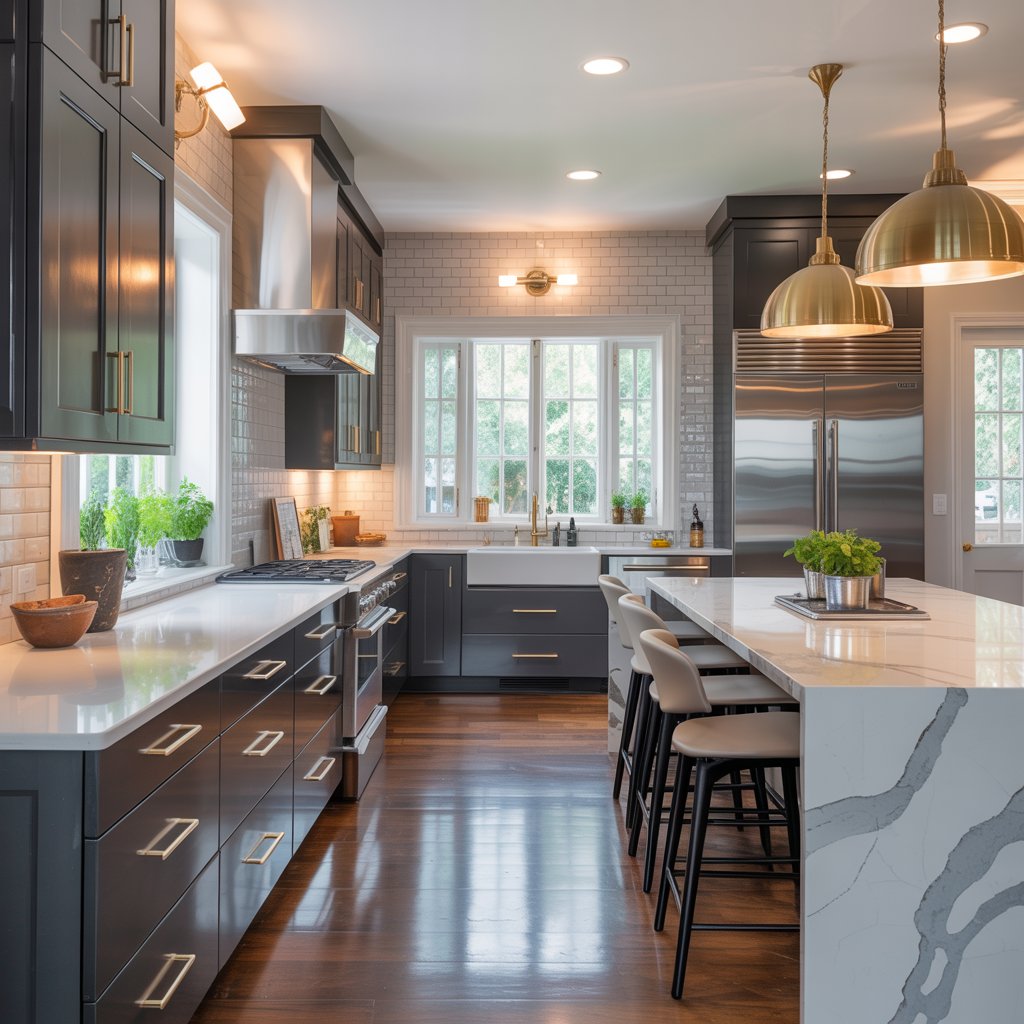
Before you pick a backsplash or fall in love with a faucet, get the bones right. These five principles underpin nearly every successful kitchen interior design project.
1. Workflow and the Kitchen Work Triangle
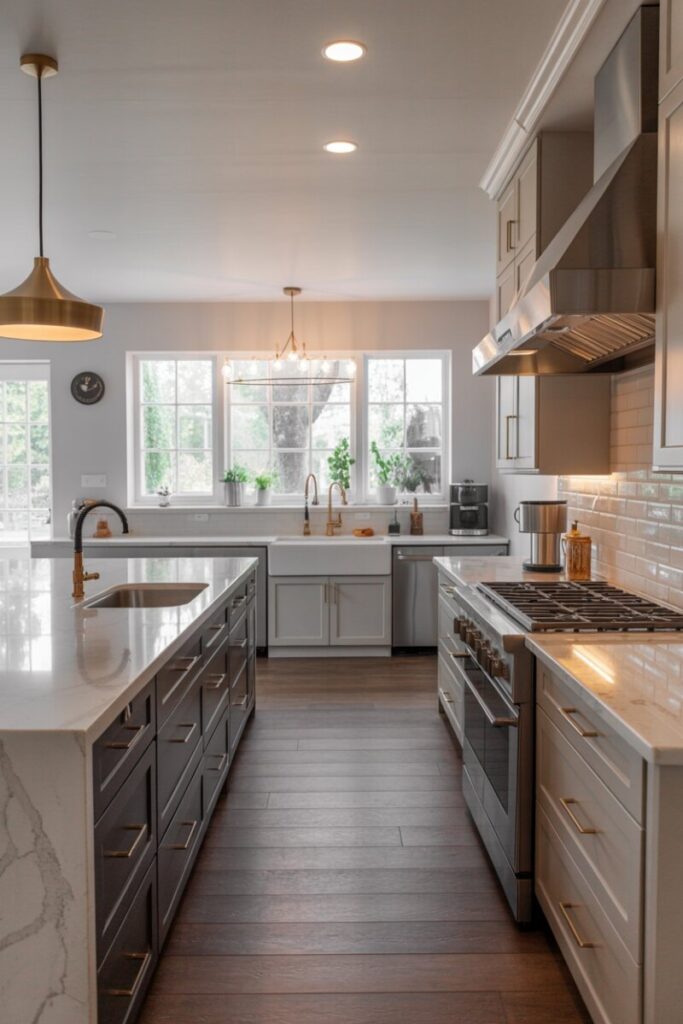
The classic “work triangle” connects the sink, cooktop, and refrigerator. For decades, designers have used it as a sanity check: total leg distance should land between 13 and 26 feet, with no single leg shorter than 4 feet or longer than 9 feet. In 2026, that idea has evolved into work zones — separate areas for prep, cooking, cleaning, and beverage-making — which handles multi-cook households much better than a strict triangle.
2. Storage-First Design
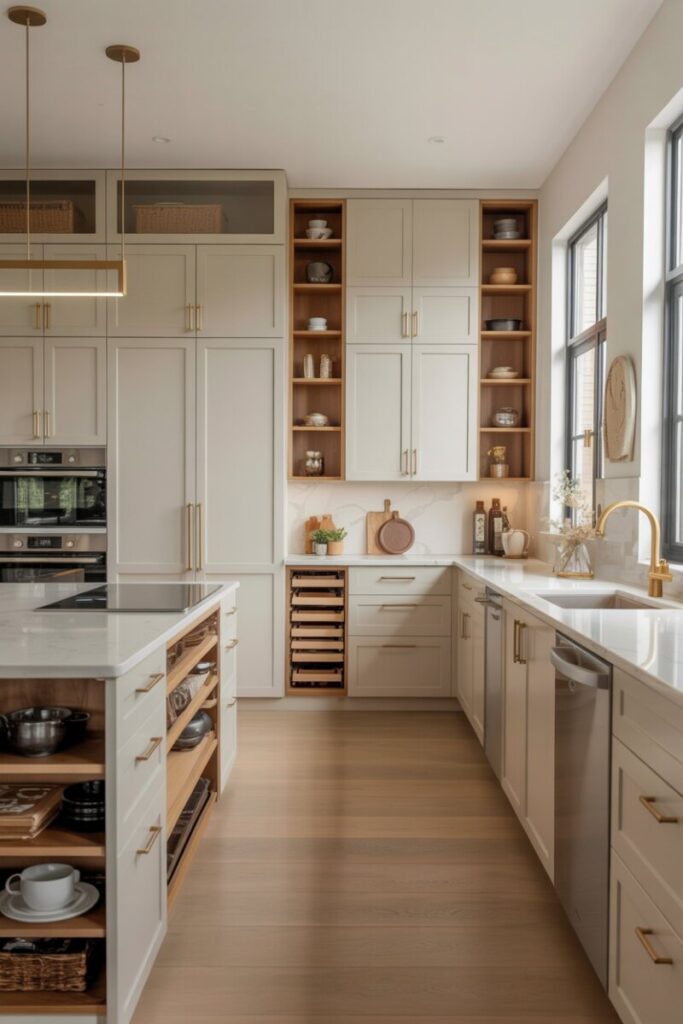
The NKBA’s 2026 Kitchen Trends Report names “storage maximization” as one of the top 11 themes in kitchen design right now. Rule of thumb: plan at least 1,400–1,700 cubic inches of storage per person in the household, plus a dedicated pantry zone, before you finalize cabinet runs.
3. Durable, Honest Materials
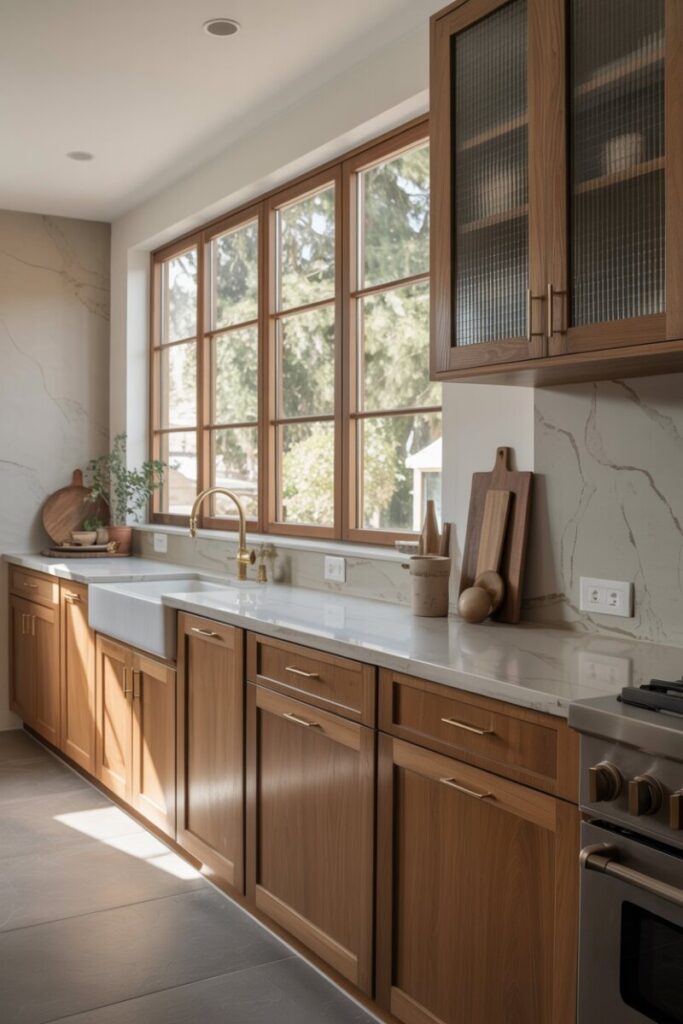
Kitchens take abuse. Prioritize durable countertop materials (quartz, quartzite, sintered stone) and hard-wearing flooring (porcelain tile, luxury vinyl plank, engineered hardwood) over anything precious. The 2026 trend leans toward materials that look better with a little patina — oiled brass, honed stone, white oak.
4. Layered Lighting
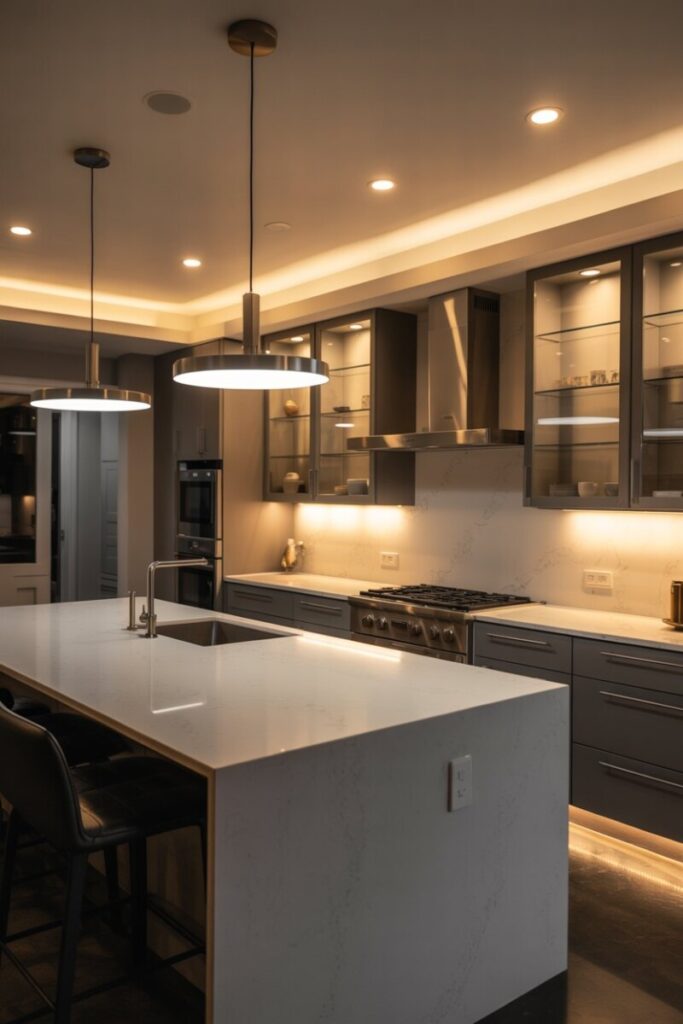
A single overhead can light is a recipe for shadows and eye strain. Plan three layers: ambient (recessed or ceiling), task (under-cabinet LED strips, pendants over the island), and accent (inside glass-front cabinets, toe-kick lighting).
5. Flexible, Multi-Use Layouts
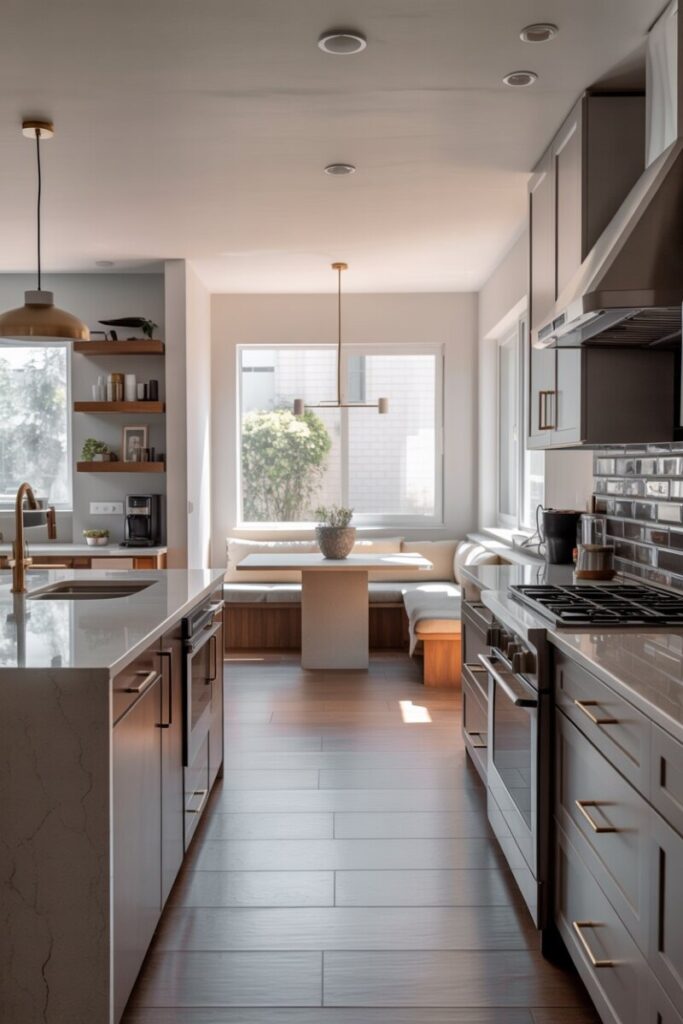
More than half of renovating homeowners (52%) modify their layout, per Houzz. The modern American kitchen has to host homework, Zoom calls, meal prep, and holiday entertaining. Build in flex zones — a peninsula with a power outlet, a coffee station, or a banquette corner — and the room will stay useful as your life changes.
Quick reference measurements to keep handy:
| Measurement | Recommended |
|---|---|
| Standard counter height | 36 in. |
| Bar-height island | 42 in. |
| Counter-depth seating overhang | 12–15 in. |
| Minimum aisle (one cook) | 36–42 in. |
| Minimum aisle (two cooks) | 48 in. |
| Clearance in front of appliances | 30–48 in. |
Popular Kitchen Layouts — and When to Choose Each
Layout is the single biggest decision in kitchen layout planning. Get it wrong and no amount of pretty tile will save the room. Here are the five layouts that dominate U.S. homes.
Galley Kitchen
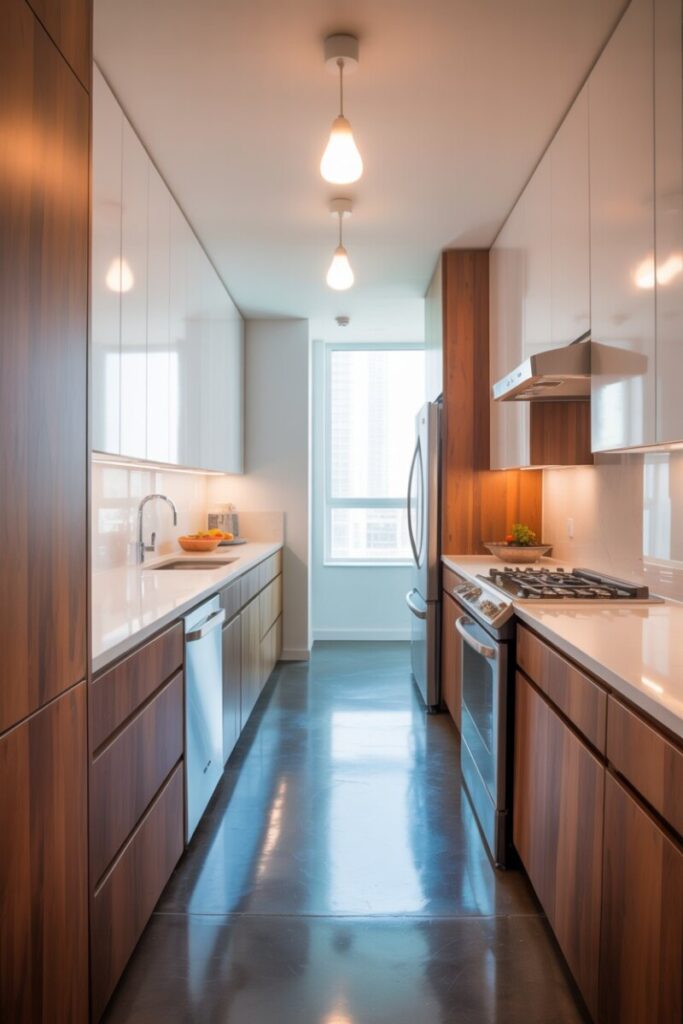
Two parallel runs of cabinets with a walkway in between. Common in pre-war apartments, ranch homes, and anywhere square footage is tight.
- Best for: small kitchen layout challenges, single-cook households, urban rentals.
- Pros: Extremely efficient workflow; everything is within arm’s reach.
- Cons: Can feel cramped with two people; limited island option.
- Keep aisles at: 42–48 in. minimum; avoid putting the sink and range directly opposite each other.
L-Shaped Kitchen
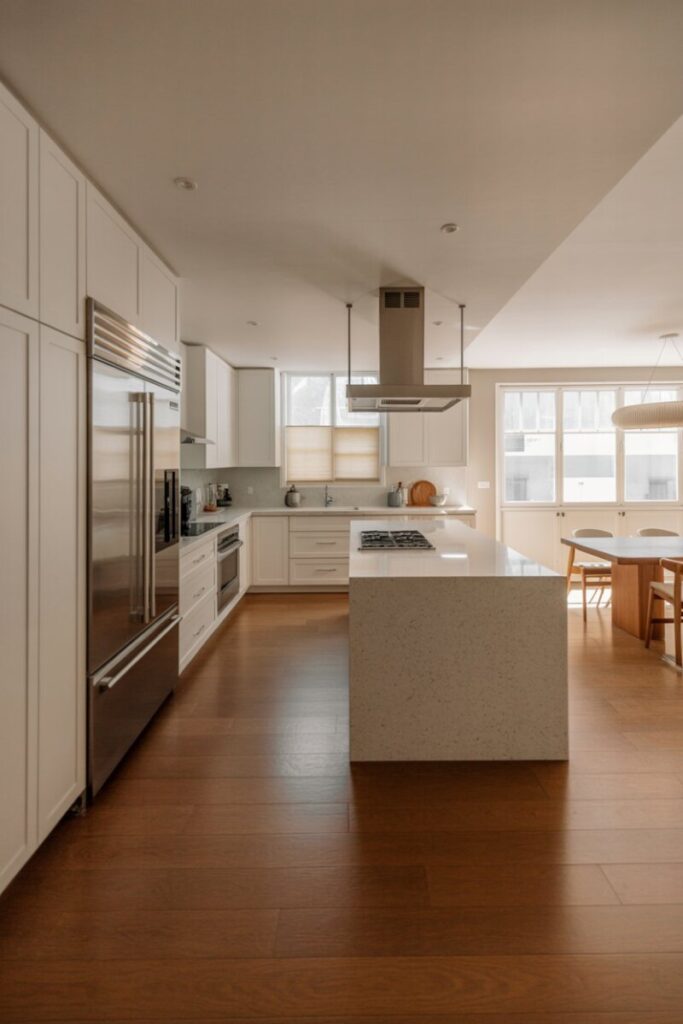
Two perpendicular runs of cabinets along adjoining walls — the layout you’ll find in a huge share of American suburban homes built between 1970 and 2005.
- Best for: Open-plan kitchen ideas where the room flows into a dining or family area.
- Pros: Naturally leaves room for a table, peninsula, or island; flexible triangle.
- Cons: Corner cabinets can waste space without a lazy Susan or Le Mans pull-out.
U-Shaped Kitchen
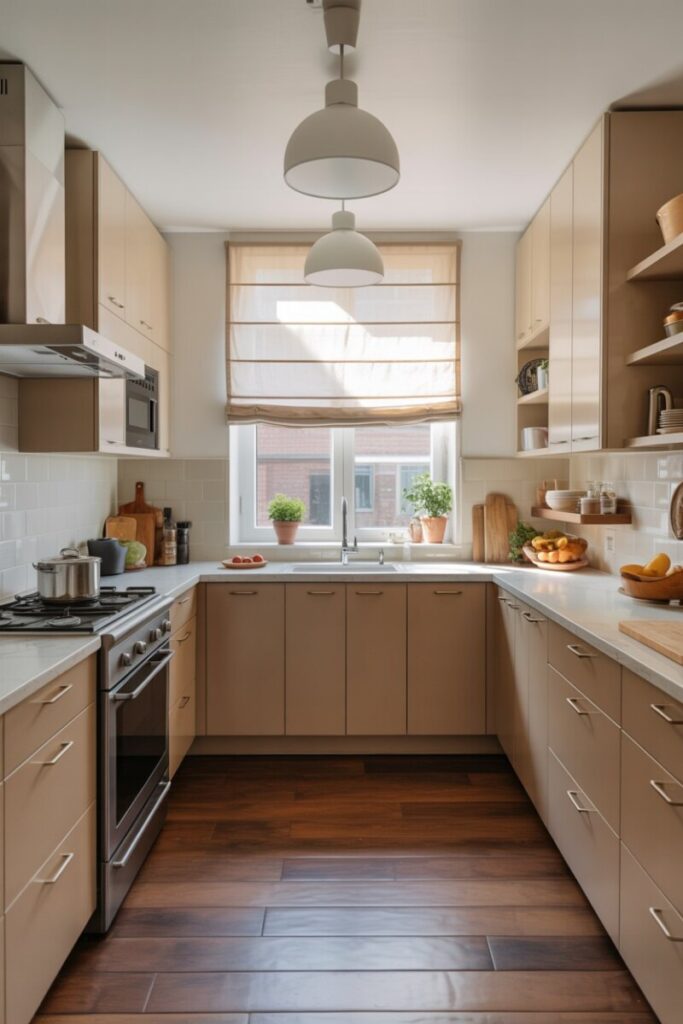
Three walls of cabinetry. The workhorse of larger homes.
- Best for: Dedicated cook spaces and serious bakers.
- Pros: Maximum counter and storage; strong workflow.
- Cons: Can feel closed off; avoid in rooms narrower than 10 ft.
Island-Centric Open-Plan Kitchen
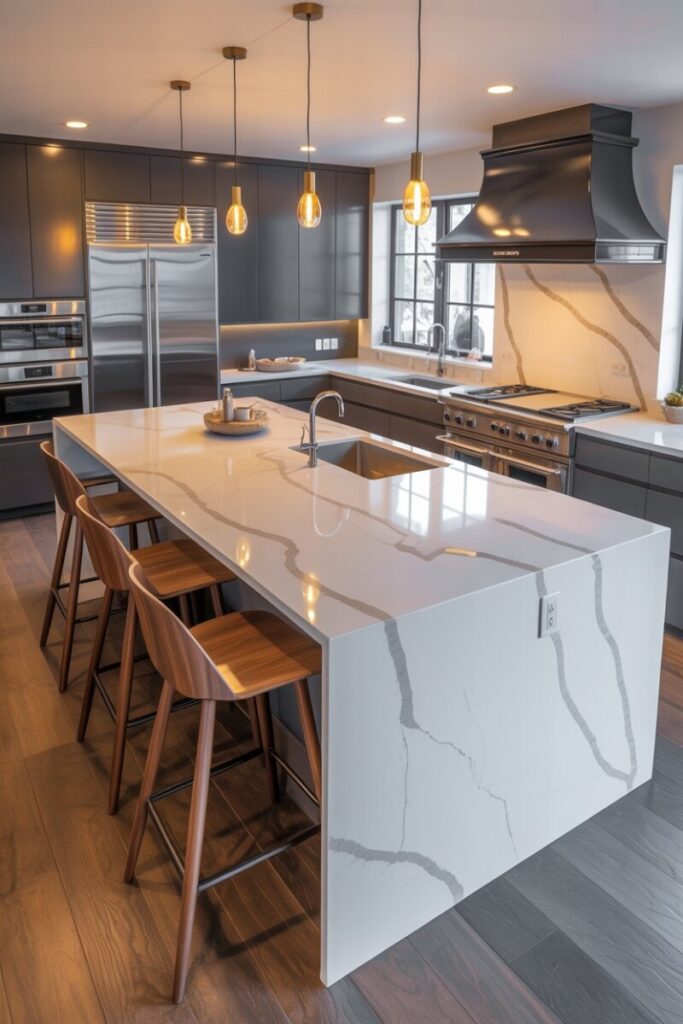
The “Pinterest” layout — and for good reason. The island becomes the prep zone, eat-in counter, and social hub.
- Best for: Families, frequent entertainers, and homes where the kitchen is the center of life.
- Pros: Adds 20–50% more prep surface; supports multiple cooks.
- Cons: Needs a room at least ~12 × 14 ft. to keep kitchen ergonomics and clearances comfortable.
Zoned Kitchen
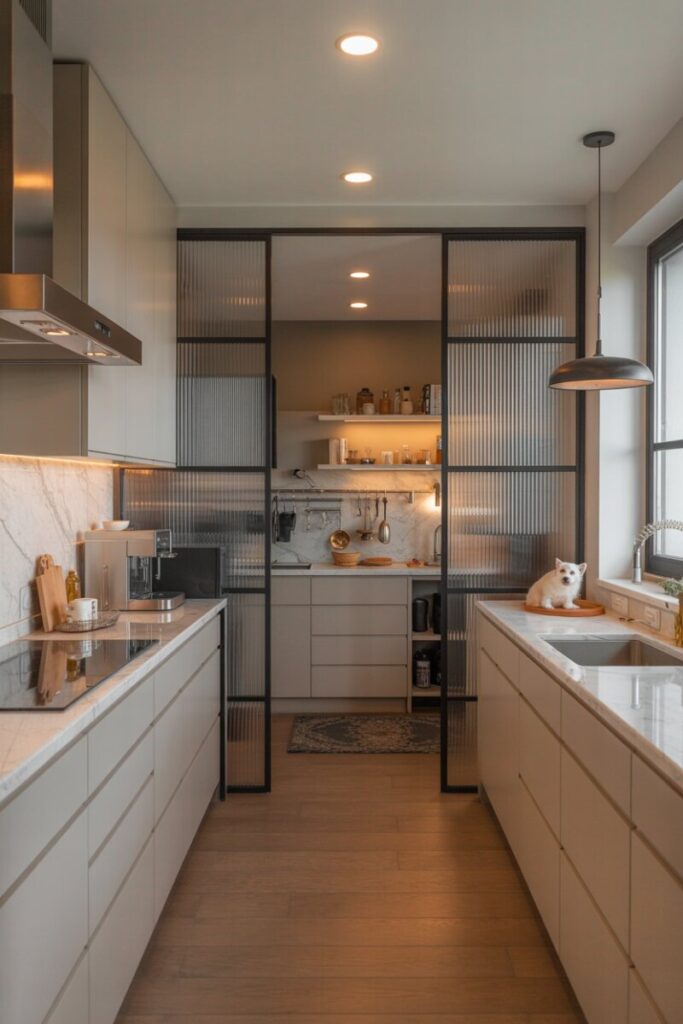
The 2026 evolution — separate stations for coffee, baking, pet feeding, or a “dirty kitchen” scullery behind the main space. NKBA’s 2026 Kitchen Trends report calls this one of the defining shifts of the year, driven by wellness and multi-generational living.
- Best for: Active households, multi-generational families, and cooks who love specialty appliances.
- Pros: Reduces congestion; lets different family members work in parallel.
- Cons: Requires more square footage and a more deliberate plan.
Internal linking suggestion: link to “How to Choose the Right Kitchen Layout for Your Home” from this section.
2026 Style Trends & Finishes Worth Considering
If you’ve been holding off because the “gray and white” era felt tired — you were right. The 2026 design cycle has officially moved on. Here’s what’s resonating with U.S. homeowners this year.
Warm Tones Replace Cool Grays
According to Fixr’s survey of 101 design experts, 67% say warm neutrals and earth tones have overtaken gray. Off-white, beige, caramel, and sage green are now base colors, with terra-cotta and saffron emerging as accent picks. Deep, moody shades like “Lush Forest” (MasterBrand’s 2026 Impactful Finish of the Year) are showing up on islands and libraries of cabinetry.
Wood-Tone Cabinets Surpass White
For the first time in almost a decade, wood-finish cabinets are more popular than all-white, chosen by 29% of renovating homeowners in the Houzz 2026 study. Light-toned stains — think white oak, ash, or rift-sawn maple — lead the category and pair beautifully with matte black or aged brass hardware.
Two-Tone Kitchen Cabinets
Two-tone kitchen cabinets remain one of the smartest ways to add personality without committing to an entire kitchen in one bold color. The classic combo: a lighter perimeter (off-white, warm beige) with a richer island (deep green, navy, walnut).
Natural Stone, Everywhere
Homeowners are rediscovering quartzite, marble, and soapstone for countertops and book-matched backsplashes. Large-format tiles (24×48 in. or bigger) are the dominant kitchen backsplash trends pick, often running from counter to ceiling with minimal grout lines for a seamless look.
Matte Black and Aged Brass Fixtures
Matte black is still going strong for faucets, cabinet pulls, and lighting, but brushed bronze and aged brass are the finishes stealing the show — warm, forgiving of fingerprints, and aging beautifully.
Smart, Wellness-First Appliances
Per the NKBA report, induction cooktops and wellness-oriented appliances (steam ovens, built-in air fryers, advanced water filtration) are the upgrades to watch. Induction is now cited by 47% of experts as one of the most sought-after kitchen features in 2026. Pair it with a high-CFM range hood if you do serious cooking.
Timeless Choices That Age Well
Trends come and go, but timeless kitchen styles share a few signatures: real wood details, simple Shaker or flat-panel door styles, quality hardware, and a restrained color palette. A kitchen that leans on these will still photograph well in 15 years.
Internal linking suggestion: link to “Best Countertop Materials Compared” (quartz vs. quartzite vs. granite vs. butcher block).
Kitchen Remodeling Cost: What to Budget in 2026
Budget is where most kitchen dreams either take off or derail. National data from Houzz, HomeAdvisor, NerdWallet, and the 2025 Cost vs. Value Report gives you a realistic range:
- National average for a standard remodel: ~$28,000 (most projects land between $15,000 and $50,000).
- Minor remodel (cabinet refacing, new counters, appliances, paint): median around $20,000; top 10% spend $50,000.
- Major midrange remodel (new cabinets, appliances, layout changes): median around $55,000.
- Major upscale remodel: can easily reach $82,000–$165,000+.
- Regional swing: Add ~35% in high-cost markets (SF, NYC, LA, Seattle, Boston). Subtract ~20% in rural South and Midwest.
Three Practical Tiers
1. Refresh — under $2,000 to $7,500 (best budget kitchen makeover approach)
Paint the cabinets, swap hardware, install under-cabinet LED lighting, replace the faucet, add open shelving in one spot, refresh the backsplash with peel-and-stick tile. Weekend-to-one-week timeline.
2. Mid-Range — $15,000 to $50,000
Cabinet refacing or semi-custom replacement, new quartz or quartzite counters, updated appliances, new lighting plan, fresh flooring. This is where most U.S. homeowners find the sweet spot between ROI and daily impact.
3. Full Remodel — $55,000+
Layout changes, structural work, custom cabinetry, premium stone, smart appliances, professional-grade ventilation. Plan for 8–16 weeks.
Where to Splurge, Where to Save
- Splurge: storage hardware (soft-close, pull-outs, organizers), lighting, and countertop surfaces. You touch them every day.
- Save: decorative tile (use it as an accent, not the whole wall), cabinet boxes (IKEA or semi-custom are excellent with upgraded fronts and hardware), and appliances (a solid mid-range package outperforms a splurge you’ll outgrow in 7 years).
Cost-saving tips that actually work: keep the plumbing and gas in place, reface rather than replace if your cabinet boxes are solid, use open shelving on one wall to cut cabinet costs by 15–20%, and consider a butcher block island top paired with quartz on the perimeter.
External authority link: [Remodeling Magazine’s 2025 Cost vs. Value Report](https://www remodeling.com).
Internal linking suggestion: link to “Kitchen Remodel Budget: Where to Spend and Where to Save.”
Lighting, Storage, and Ergonomics: The Details That Make or Break a Kitchen
This is the section that separates a pretty kitchen from a kitchen you actually love cooking in.
Kitchen Lighting Ideas That Work
- Ambient: Recessed cans on dimmers, spaced 4–5 ft apart in a grid. Aim for 3,000K color temperature — warm enough to be inviting, crisp enough to see food clearly.
- Task: Under-cabinet LED strips (CRI 90+ is worth the upcharge) mounted toward the front edge of the upper cabinet so light hits the counter, not the backsplash.
- Accent: Small in-cabinet LEDs with glass doors, low-profile toe-kick lighting, or a single sculptural pendant above a coffee station.
- Controls: Put each layer on its own switch or smart dimmer. You want the flexibility to go from “meal prep mode” to “evening hangout” in one gesture.
Kitchen Storage Solutions That Earn Their Keep
- Deep drawers over base cabinets for pots and plates — up to 30% more usable storage than shelves.
- Pull-out pantries or a full walk-in with adjustable shelves; NKBA notes floor-to-ceiling pantry storage is a top 2026 demand.
- Appliance garages with flip-up or bi-fold doors to hide the toaster, coffee maker, and blender.
- Trash and recycling pull-outs next to the sink — non-negotiable in a modern layout.
- Vertical dividers near the oven for sheet pans, cutting boards, and serving platters.
- Corner solutions: Le Mans pull-outs (the best-performing) or blind-corner rollout systems.
Kitchen Ergonomics in Plain English
- Standard counter height is 36 in.; raise to 39–42 in. at a standing-height island for taller users, or add a lowered 30–32 in. baking station for shorter cooks.
- Keep the dishwasher within 36 in. of the main sink, and on the dominant-hand side for the primary user.
- The microwave should live between 24 and 48 in. off the floor — drawer-style microwaves are a 2026 favorite for exactly this reason.
- If anyone in the home has mobility needs, review ADA-recommended clearances (minimum 60-in. turning radius, 34-in. max counter height) — good universal design helps everyone.
Internal linking suggestion: link to “Smart Kitchen Storage Solutions for Every Budget.”
External authority link: ADA.gov — Kitchen Accessibility Standards.
Before & After: A Suburban Kitchen Opens Up on a Realistic Budget
The home: A 1996 colonial in suburban Atlanta with a closed-off 11 × 13 ft. U-shaped kitchen and a single awkward pass-through to the dining room. Two adults, two kids, one overworked island-less layout.
The problems: No island, no pantry beyond a shallow 18-in. cabinet, shadows everywhere after 3 p.m., and zero connection between the cook and the rest of the family.
The plan (and cost): Remove a non-load-bearing wall, convert the U-shape to an L-shaped layout with a 9-ft peninsula that doubles as seating and storage, add a full-height pull-out pantry, install a layered lighting plan (recessed cans + two large pendants + under-cabinet LEDs), and reface existing cabinet boxes with new Shaker fronts in a two-tone kitchen cabinet scheme — warm white oak uppers, deep sage lowers. New quartz countertops, induction range, and a luxury vinyl plank floor to tie it into the adjoining family room.
Results:
- 42% more usable storage (measured by cubic inches)
- Prep surface increased from 22 to 48 linear feet
- Per Houzz benchmark, timeline ~10 weeks, total spend $48,000 — slightly above national median because of the wall removal and electrical rework
- “We basically gained a family room back,” the homeowner reported four months in. Dinner prep and homework now happen in the same room without anyone feeling crowded.
Your Kitchen Planning Checklist (Print This)
Before you hire anyone or buy anything:
- [ ] Measure the room to the nearest ⅛ inch — walls, ceiling, windows, soffits, HVAC vents, gas line, and plumbing stack.
- [ ] Decide layout first, style second.
- [ ] Identify your #1 and #2 workflow pain points (e.g., “no landing space next to the fridge,” “trash blocks traffic”).
- [ ] Set the budget tier and the contingency (add 15–20%).
- [ ] Choose cabinet door style, finish, and whether you’re doing two-tone.
- [ ] Pick countertop and backsplash materials together — test samples in your lighting.
- [ ] Finalize appliance package before cabinet order (sizes vary by brand).
- [ ] Plan the lighting in three layers; mark switch and outlet locations.
- [ ] Confirm permits needed — electrical, plumbing, and structural changes typically require them.
- [ ] Ask contractors: Are they licensed, insured, and pulling permits? Who is the on-site foreman? What’s the week-by-week schedule?
- [ ] Expect 6–16 weeks from demolition to final punch list for a mid-to-large remodel.
Ready When You Are
A great kitchen isn’t about chasing every trend — it’s about building a room that fits your mornings, your weekends, and the decade ahead. Whether you start this weekend with a fresh coat of paint and new under-cabinet lighting or spend the next six months planning a full transformation, the checklist above gives you a real starting line.
Save this post, pin your favorite layout, and share your before-and-after in the comments — we read every one. If you want a second set of eyes on your plan, consider booking a one-hour consult with a local certified kitchen designer; it’s one of the highest-ROI spends in any remodel.